
Material Correspondence
On Friday, I sent off my wonky little silk pojagi to Washington, US., for the first round of Material Correspondence. I'm sharing some thoughts on postal art and slow, stitched connection.

A few months ago I set up Material Correspondence with some of you here on Substack, friends back in Sweden, and a few people from elsewhere online. The spark was the Postal Art Event, which I found through Nicole Nehrig’s With Her Own Hands— if you haven’t read it - you should. And yes, Nicole is in this project too.
The original Postal Art Event was an open call that travelled by post, hand to hand, collecting marks, messages, stains—small decisions. A slow conversation on paper. It was even described as a “long-distance consciousness-raising session,” but it began simply: two neighbours, Sally Gollop and Kate Walker, trying to stay close after one moved away. Feminists, mothers, artists—making work while raising families, using what they had at home and what could be posted. Small scale, high intimacy. Quietly defiant. Walker later recruited new participants at the 1975 Women’s Art History Conference in London.
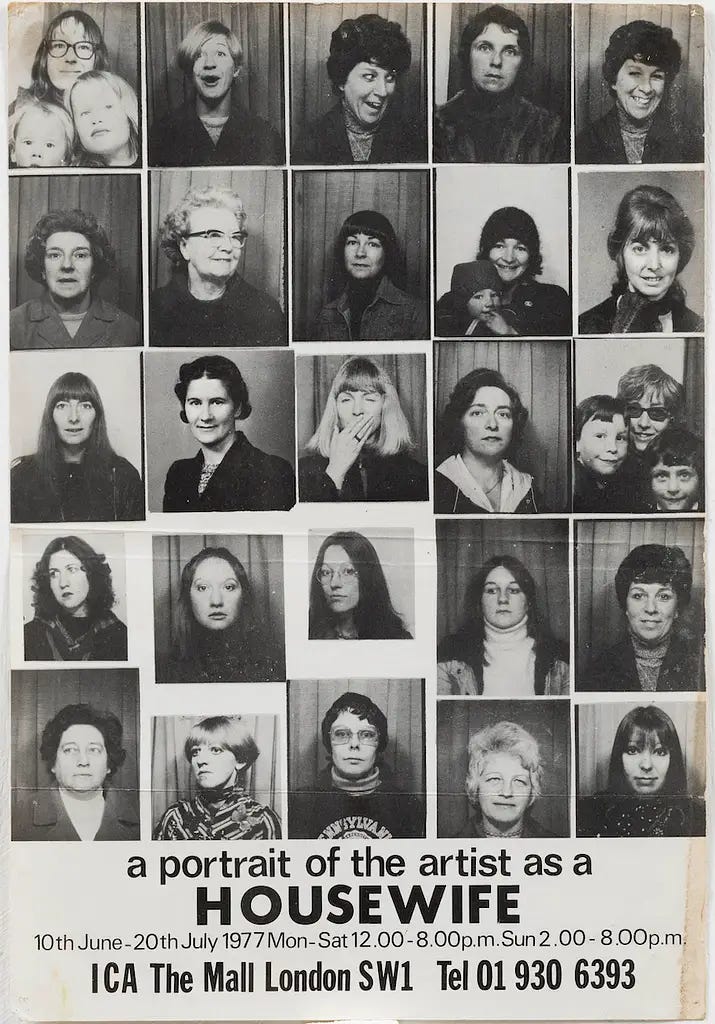
What I love about it is how it makes space for people whose lives are already full. No studio required. No precious materials. No big reveal. Postal art is private until it isn’t. It moves through kitchens and living rooms and between nap times. The work gets made where life is happening.
While researching, I found Su Richardson speaking about the practicalities—how you make around tiredness, money, time, other people’s needs. She described the relief of an exchange where the work doesn’t need to be big to matter, and where the audience is one person at a time. That tenderness and grit is what I want this project to hold. This video of Su speaking about her work really moved me.
Then I found Monica Ross, another participant—working with text, performance, protest, care. Public work that still keeps its intimacy. Her work is not academic, not decorative, but it has a steady sort of insistence about it: ordinary lives are worth taking seriously.
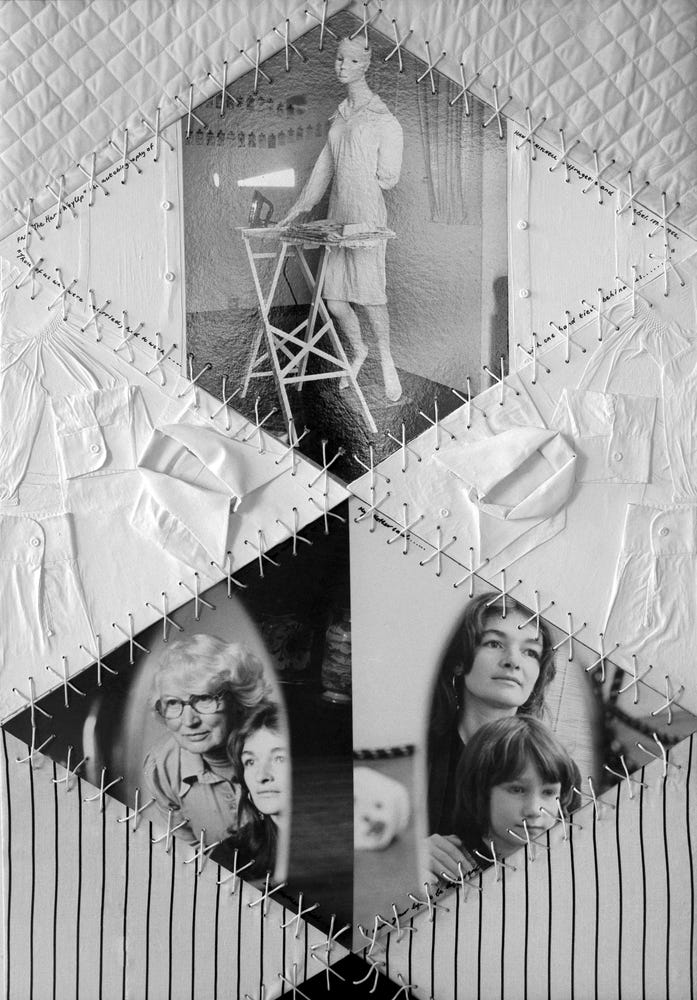
I know so many women who are artists or crafters and now also mothers, or carers, and who find it hard not only to make, but to be seen as makers. Motherhood can be isolating. Conversation narrows. You end up saying, shyly, “Oh, I used to…” You keep things light. Breezy. Passion feels awkward unless it’s kid-adjacent. And yet the desire to be seen and heard doesn’t go anywhere. (For the record: this isn’t only about art. Here in Cambridge, plenty of mothers are scientists, historians, anthropologists—and they often downplay their work too, as if it is something to mention quietly, or as if they assume people won’t be interested, or won’t have time to listen)
Material Correspondence is my attempt to widen the room again. A thread of connection between women (and anyone who relates to this kind of making) across places and circumstances. I wanted it to be something tactile and real, something that keeps our hands moving, keep in touch—without pretending we’re unencumbered.
The structure has been really simple: each participant receives an envelope from someone else in the circle. Inside is a small piece—knitted, sewn, stitched, collaged—made for one person, then sent on. I’ve seen sneak peeks and I’m honestly amazed. There’s so much talent happening quietly at home, alongside paid work and care. This sits somewhere in the middle: not a diary, not a feed. We can make something that belongs to us, not as a product, but as proof of presence.
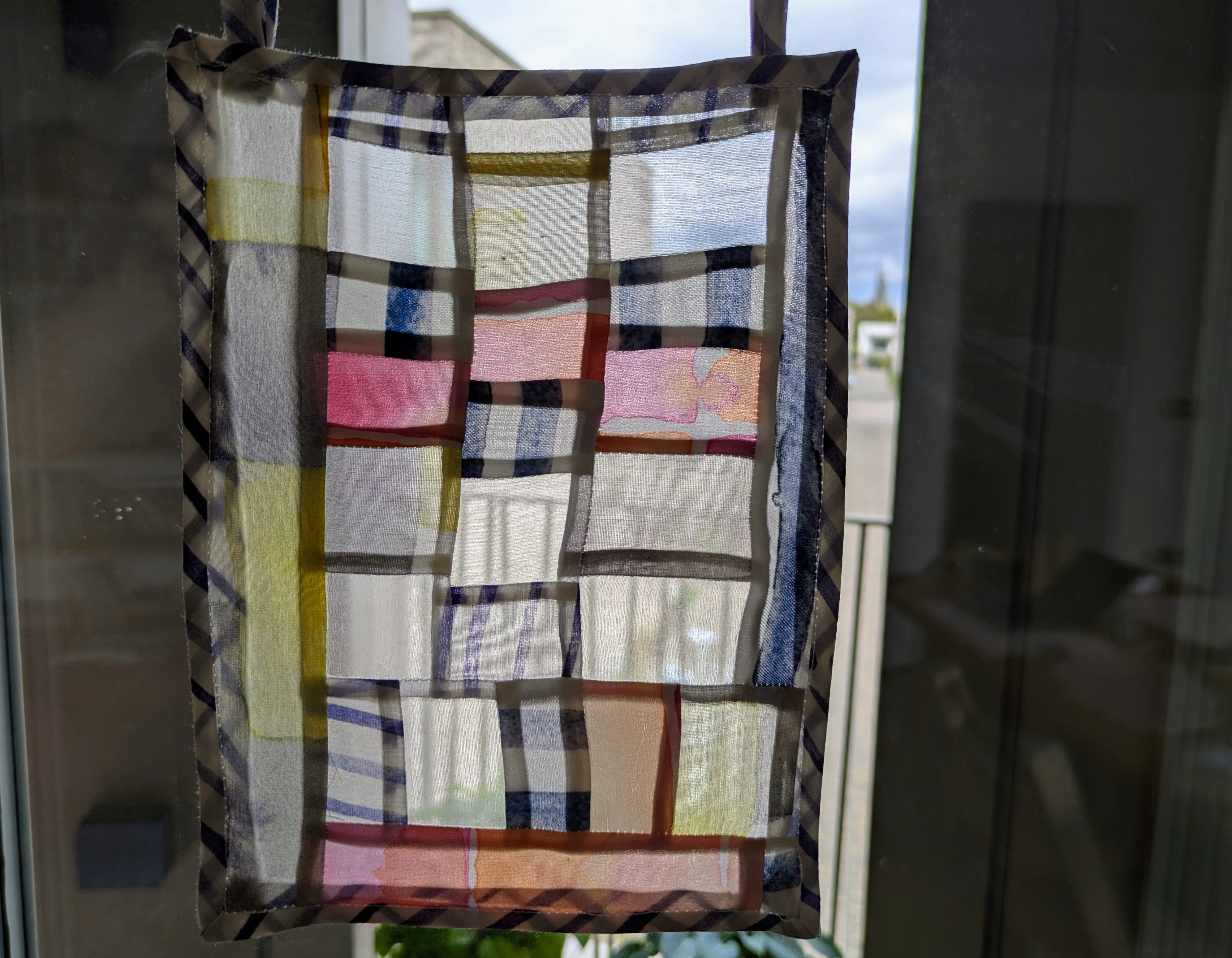
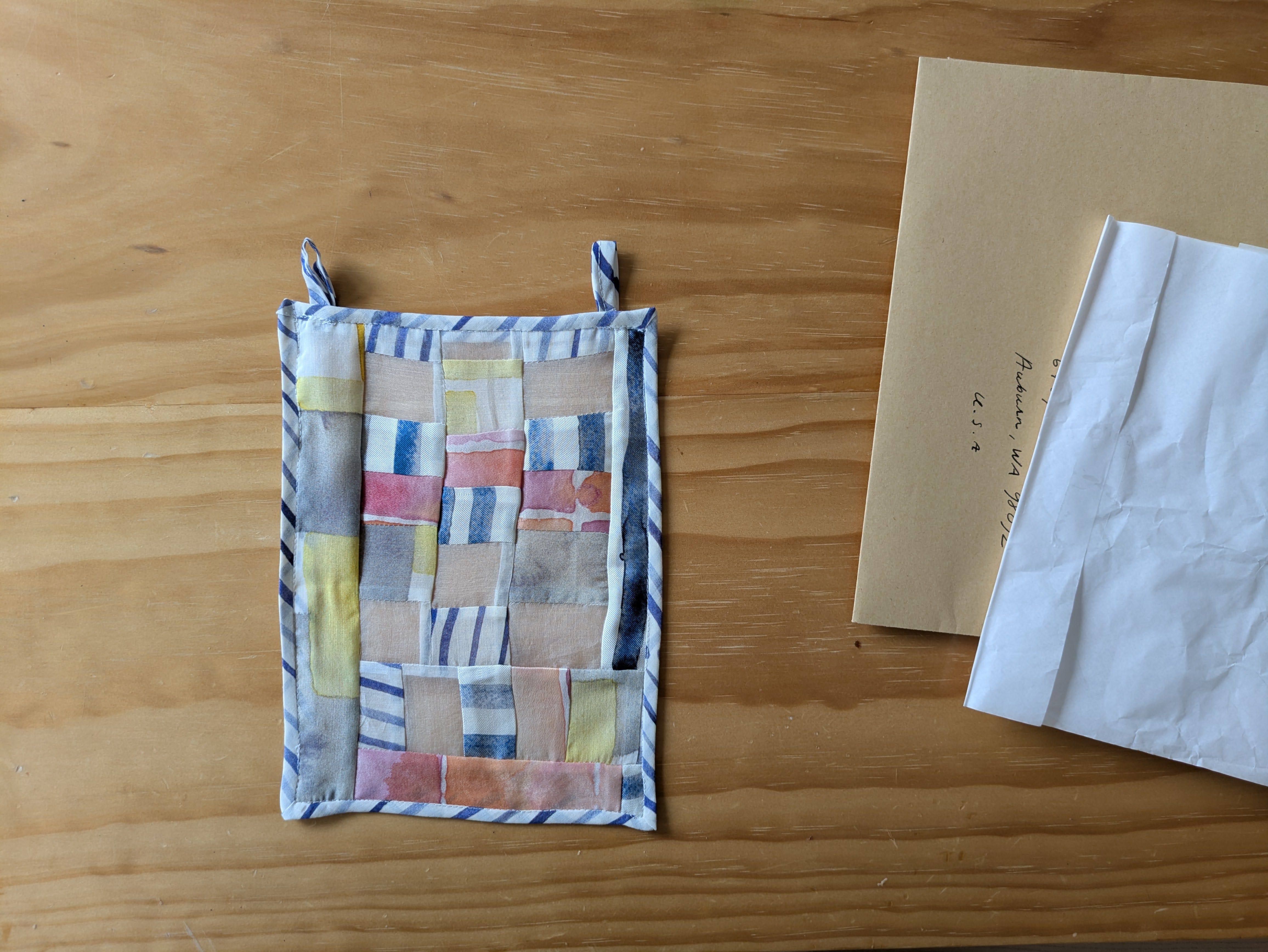
For my piece, I’m sending to Holly in Washington, US, I made a tiny A5 pojagi from scraps of textiles I produced while running my brand Ever Rêve. Pojagi—Korean patchwork wrapping cloths—have been doing the rounds on social media for years, so I’m late to the bandwagon. But the thing I love is the root of it: jogak-bo (“small segments”)—offcuts, thrift, turned into colour and possibility. Like so much textile work, it carries a history of women making at home: saving scraps, sorting them, cutting shapes, piecing new cloth into being. I won’t over-intellectualise it, but textiles always do this to me—they pull me into that long, unbroken conversation between women making with what’s available.
Mine isn’t perfect. The pieces got stretched while sewing. It’s a bit wonky. I sewed with my daughter on my lap in the evenings. But it is what it’s meant to be.
I don’t know what will come back to me at the end of the chain. Maybe a beautiful pile of fragments. Maybe something that looks like nothing much at all. But I’m already grateful for what it’s changed: the anticipation of the post, the permission to spend twenty minutes with cloth, the feeling of being in dialogue with someone I might never meet.
The original Postal Art Event was a way of saying: you don’t have to wait until you’re ready. Begin with what’s in front of you. This is my version of that invitation. I’d love to hear how it’s been for you—what you’ve made, what it’s stirred up, and what you’d want from a round two! Please share below.
Love
Michelle
either way, i want a round two! as a textile artist who's just starting out trying to sell her stuff, knowing I have a built-in audience on the other side of a shipment is extremely freeing. Make art, release it, thus is the path of the artist
Thank you for bringing us together and organizing this project! It is comforting reading your thoughts on the meaning and intention of the exchange. It is so hard to maintain the attitude that small, modest acts of creativity are enough (and indeed, very important). Excited to see what others share too! So much gratitude for you.